Cerro Otto sits inside Bariloche's Nahuel Huapi National Park, rising to 1,405 meters above sea level on the shores of Lake Nahuel Huapi. It owes its name to Otto Goedecke, one of the first pioneers to settle a farm on the mountain's slopes.
In winter, everyone comes for a season of skiing and other snow sports like Nordic skiing, snowboarding, sledding, and more. For the rest of the year, the slopes reinvent themselves so you can ride down on inflatable tubes, and trekking, ziplines, and playgrounds turn every visit into an unforgettable experience. These and other not-to-be-missed plans are in our catalog of Bariloche tours and excursions.
Cerro Otto at a glance
- Height: 1,405 meters above sea level
- Distance from downtown Bariloche: 5 km
- How to get there: by car, on bus line 50, or on the free shuttle offered by the cable car complex itself from downtown
- Cable car: 42 gondolas with room for 4 people each, covering a 2,100-meter route
- Usual ticket office hours: 10 am to 5 pm for the last ascent (check current hours before you go, as they vary by season)
- Ski season: June to August
- Free activity we recommend: the walk to Piedra de Habsburgo from the summit
- Note: hours and prices may change depending on the season. Before your visit, we recommend confirming current details on the official Teleférico Cerro Otto website.
When's the best time to visit Cerro Otto?
It depends on what you're after: winter (June to August) is ideal for skiing, ziplining, and sledding at Piedras Blancas, while spring and summer are better for trekking, ziplining, and the activities at EUCA and Otto Kart.
Below, we've put together the most complete guide to what to do at Cerro Otto.
Take the Cerro Otto cable car
Just 5 kilometers from downtown Bariloche is the base of the complex, home to the main attraction: riding up through the historic cable car. This lift system has 42 gondolas, each holding up to 4 people, running from the lower station to the upper station.
The cable car climbs to a height of 2,100 meters, opening up spectacular panoramic views. The entry ticket to the complex covers the ride up and down plus access to the revolving café, the art gallery, and a children's play area, along with guided walks at set times depending on weather conditions. The complex also offers extra activities for an additional fee, like ziplining and a climbing wall.

A little-known fact: the tourist complex belongs to the Fundación Sara María Furman, which channels part of the proceeds from every ticket into local charitable causes, including the Cooperadora of Bariloche's Ramón Carrillo Zonal Hospital. We recommend checking current rates and hours on the official Cerro Otto cable car website before your visit, since they can vary by season.
Can you go up Cerro Otto for free? Yes. You can drive to the summit without paying for the cable car, and from there do the free walk to Piedra de Habsburgo. There's also the option of hiking up on foot from the city along the trail that leads to Refugio Berghof.
Hike to Piedra de Habsburgo
Looking for something short, free, and suitable for the whole family? The walk to Piedra de Habsburgo is one of the best options on the mountain. You can drive up to the summit and then complete a short stretch of trail on foot — ideal for anyone just starting out on mountain walks or with limited time.
From this spot, the view opens up to the north, with the city of Bariloche and Lake Nahuel Huapi in the background. It's the perfect complement to the revolving café or the art gallery, with no need to add any extra paid activities.
Visit the Art Gallery
Who said you can't take in art and culture up in the mountains? This gallery, located on Avenida Los Pioneros at kilometer 5000, permanently displays exact, life-size replicas of Michelangelo Buonarroti's three most famous, world-renowned works: La Pietà, David, and Moses.
Although they're made of 80% marble dust and 20% acrylic resin, visitors swear how incredibly close they are to the originals.

Dine at the revolving café with panoramic views
Who wouldn't want to enjoy a good hot chocolate after playing in the snow while taking in the scenery from every angle? This café makes it possible, since it rotates a full 360° and is enclosed in glass all the way around! The café completes a full rotation in roughly 20 to 40 minutes, depending on the day's rotation speed.
The café turns at a comfortable, pleasant pace, is fully glazed, and heated by a hot-air system that lets you relax after each activity. It seats up to 250 people, and at lunchtime you can savor delicious smoked specialties like venison, wild boar, trout, or salmon, plus sweet treats in the morning paired with coffee, tea, and the essential hot chocolate to recharge your energy.
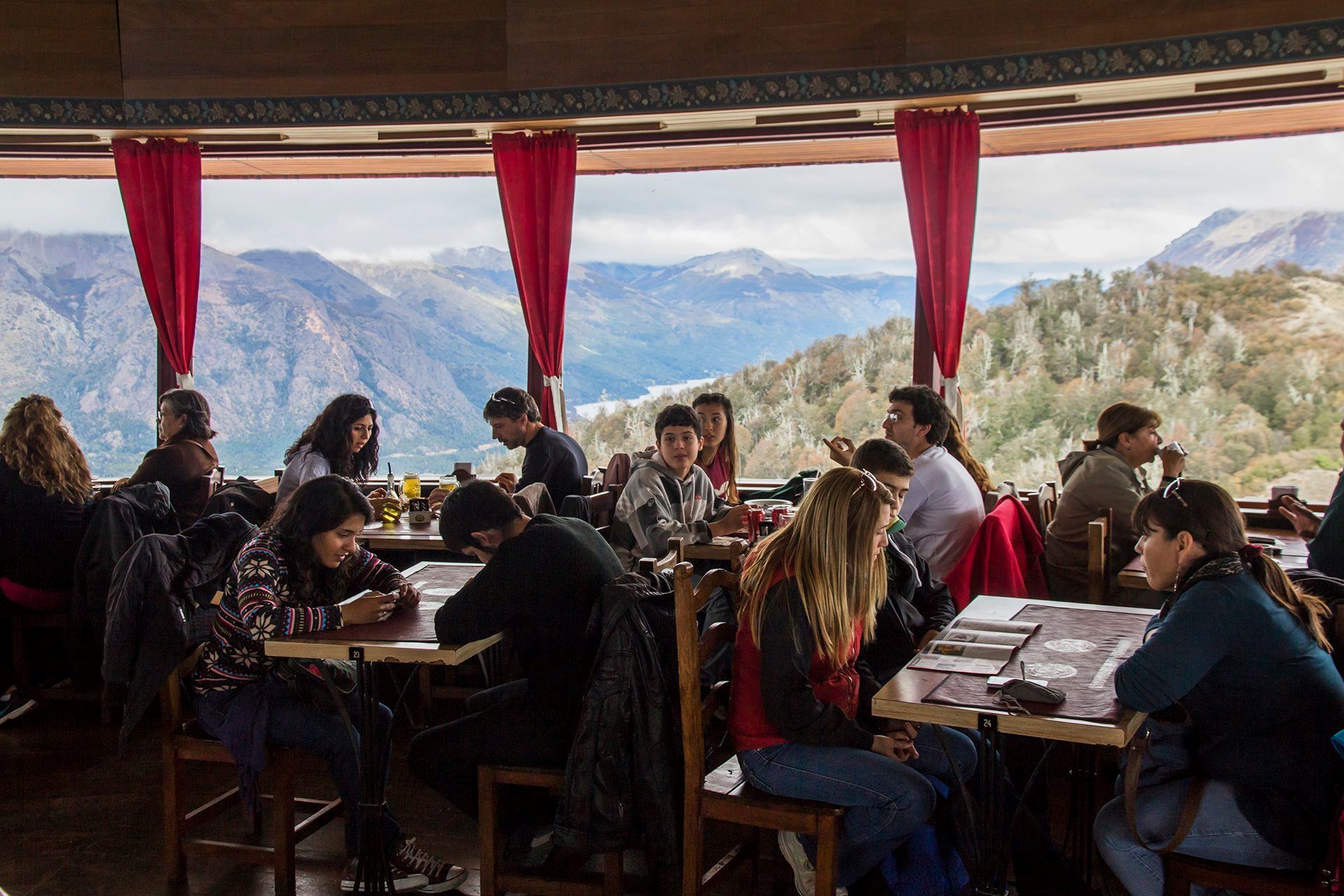
To reach the mountain café, head to the base of the complex (5 kilometers from downtown) at kilometer 5 of the Faldeo road and take the gondola lift (known as "la manzanita"). After 12 minutes, at 1,405 meters above sea level, you'll find the revolving café, open every day from 10 am to 8 pm.
In summer, you can also get there via a 10-kilometer trek from the city — about 3 hours of walking on moderately difficult trails. The route starts on Avenida Belgrano, continues to the Cerro Otto access road (a gravel road) on Avenida de los Pioneros, and from there it's 6.5 kilometers to the café.
Winter activities at Piedras Blancas
Piedras Blancas is the birthplace of skiing in Argentina. Its slopes were used by the country's very first skiers. According to local lore, back then people would hike up and ski all the way back down into the city of Bariloche itself.
Chairlifts take you up to the start of the runs — a 3,000-meter stretch of dedicated slopes — where you can then come down by sled ("culipatín," as it's known locally) or by zipline, soaring over the forest below. There are also ski and snowboard lessons for beginners, a café, and stunning views of Lake Nahuel Huapi and Lake Gutiérrez.

There's also a photo safari to discover incredible scenery, a great activity to share as a family. You can get there from downtown by rental car or bus — about 15 kilometers in total, heading out along Avenida Exequiel Bustillo to the intersection with the Cerro Otto access road, then another 5.5 kilometers to the ski center's parking lot.
Piedras Blancas is open year-round, with the winter sports season running from June through August. During spring and summer (September to March), it offers other activities like trekking, hiking, ziplining, climbing, and tubing down the slopes (raftubing).
High-ropes course and zipline at EUCA
EUCA is an aerial adventure park inside the Piedras Blancas complex, 15 kilometers from the city. It has 5 levels and 60 challenges, including ziplines, hanging bridges, nets, steel loops, wooden tubes, and more. It's a great spot for families or friends to relive their childhood while playing and climbing among the trees.

EUCA is built to the strictest European safety standards required for this kind of activity. To take part, you'll need to meet these minimum height requirements:
- Level 1: minimum height of 1.25 m or 6 years old
- Levels 2 and 3: minimum height of 1.40 m or 9 years old
- Levels 4 and 5: minimum height of 1.60 m or 14 years old
The park also offers a special experience for little ones: Euca Mini, a scaled-down area where kids can take on challenges independently and safely, testing their skill and mobility.
During January, February, and winter school holidays, it's open every day from 10 am to 8 pm. In low season, it's open Thursday through Sunday (including holidays) from 10 am to 5:30 pm.
Otto Kart
When the snow melts away at the Teleférico complex, Otto Kart takes over: with its vinyl-covered tracks overseen by trained staff, it lets you experience racing down the mountainside on large inflatable tubes. A serious adrenaline rush!
These big, Canadian-style inflatable tubes are used to speed down fun slides. As with the sleds, it's an activity where you pick up speed with no risk, always under staff supervision. You descend along a 300-meter track with banked curves.

At the bottom of the run, you head back up on the summit funicular, the only means of transport at the top of the mountain. This activity only runs outside the winter season, from October to March.
Getting to the Otto Kart track is simple: head to the intersection of Avenida de los Pioneros and Avenida Sara María Furman (just 5 km from the city of Bariloche). That's where the Complejo Turístico Teleférico Cerro Otto is located, with the lower station and its 42 gondolas (each seating four people) taking you up to the upper station at 1,405 meters above sea level. The ride covers 2,100 meters at a steady speed of 3 meters per second. Once at the top, you'll find the recreation area.
Visit the historic Refugio Berghof in Bariloche
Refugio Berghof offers a beautiful panorama over Lake Nahuel Huapi and the city of Bariloche, and was once home to pioneer Otto Meiling, founder of the Club Andino Bariloche. This same spot was also home to South America's first ski factory and first ski center. The current shelter was rebuilt and reopened in 2013, after fire destroyed the historic original structure two years earlier.
Berghof is the closest shelter to downtown, reachable in about a 2-hour walk. It has a spacious dining hall, a fully equipped kitchen, and a pantry, built mostly of wood. Visitors can tour don Otto's former home, now turned into a museum, or take part in the Sturm und Drang music series (jazz, funk, and Latin music), held on the first nights of May, December, and February.

In the 1930s, Meiling built several structures: his own house; the shelter first named "Bergfreude" (German for "mountain joy"), later renamed "Berghof"; two bungalows known as Tábanos and Pichi Ruca (Mapuche for "little house"); and a workshop where skis were made. Thanks to this workshop, and the drive of Otto Meiling and other European settlers in the region, the Tronador ski school was born — and so began Bariloche's transformation into the international ski destination it is today.
How long is the hike to Refugio Berghof? The easiest trail starts from the Club Andino Bariloche shelters. It departs from kilometer 1 of Avenida Pioneros and takes about 2 hours (7 km) along a gentle slope.
You can also get there by car or by taking the cable car (the station is at Av. Pioneros, kilometer 5). To hike up to the shelter, take the trail running alongside the road that starts at kilometer 1 of Avenida Pioneros. From downtown Bariloche, take Avenida Exequiel Bustillo to RP82, turn left toward the Cerro Otto access road, and drive 5 kilometers to the shelter.
If you're planning to hike on your own, keep in mind that Nahuel Huapi National Park requires mandatory trekking registration for anyone heading into the mountains: you'll need to report your planned route, the days you'll be out, your gear, and an emergency contact. Club Andino Bariloche, founded in 1931 and the caretaker of most of the area's shelters, is a great resource if you have questions about trail conditions or weather before heading out.
Visit the Nordic Ski Center
13 kilometers from the city of Bariloche, on the steep slopes of Cerro Otto, you'll find the Centro de Ski Nórdico, a great spot to ski at 1,280 meters. It runs throughout the winter season (June to August), keeping the trails groomed with snow-making machines. As the name suggests, the center is dedicated to Nordic skiing, letting skiers move along forest trails and even climb uphill thanks to the special shape of Nordic skis.
The complex stands out for its more than 10 kilometers of trails, designed for every level and both Nordic techniques: skating and classic. It also offers other fun activities like ATV rides, snowmobiling, and snowshoe hikes. During the winter season, the trails are open from 9:30 am to 5:30 pm.

The center's ski school rents equipment and offers lessons starting at age 5. On this track of over 3,000 meters, you'll also find a sledding run. The circuit is marked with different difficulty levels to suit every taste and age. The trails wind through dense forests of lenga, European pine, ñire, and notro trees, among many other species.
And to top off your visit to the ski center, there's a mountain lodge perfect for enjoying top-notch food after an afternoon of skiing. For more on places to rest up in the mountains, check out our article on Bariloche's mountain refuges.
Dine at Refugio Arelauquen
Refugio Arelauquen sits on a lookout point at 1,300 meters, on the southern summit of Cerro Otto.
It stands out for its outstanding mountain restaurant with unbeatable views. Everyone's favorite? The cheese fondue and the chocolate fondue! They also serve delicious asparagus and onion soups, plus a varied menu of venison, pork, and fish. Another standout dish is the grilled trout with chive cream and noisette potatoes.

Another lovely experience here is the Nordic night. You'll be amazed by the nighttime scenery while enjoying a delicious homemade dinner at the shelter in the middle of the mountains. The tour departs from the city up to Cerro Otto, where you ride up to the summit by 4x4. From there, you set off on a one-hour ATV circuit to the lookout point, where you can take in the city of Bariloche fully lit up below.
You can reach Refugio Arelauquen by car or on foot. By car from downtown, take Avenida de los Pioneros to RN40, follow it for 12 kilometers to the De los Pañiles gravel road, continue for 5 kilometers to the sign pointing toward Refugio Arelauquen. On foot (13 kilometers), it's best to take the trail (Refugio Arelauquen) running parallel to RP82 from Avenida de los Pioneros.