Recoleta Cemetery is one of the most visited sites in Buenos Aires, and also one that raises the most questions before a visit: who's buried there, how much the entrance costs, whether it's worth joining a guided tour, and what to do in the neighborhood afterward.
This guide answers each of those questions with the detail you need to plan your visit — from the history of the site to its famous graves and the legends surrounding it. You'll also find recommendations for excursions and tours in Buenos Aires to round out your itinerary.
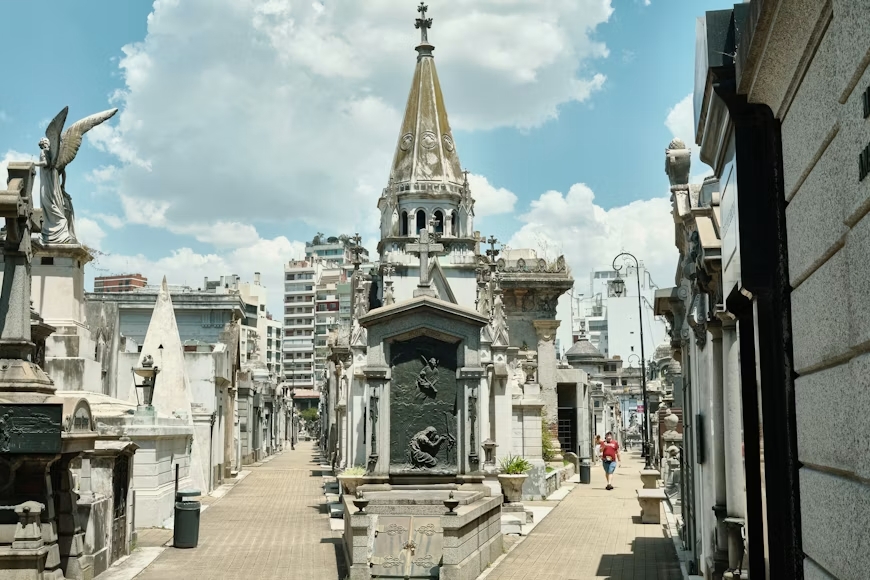
The cemetery was founded in 1822 as the city's first public burial ground, and today it works like an open-air museum: more than 6,400 vaults and mausoleums line a network of internal pathways that feels like a small city. More than 200 major figures from Argentine history rest here, including Eva Perón, former presidents, scientists, and Nobel laureates, along with the families that shaped the country's economy and politics for over a century.
Below, we go in depth into the cemetery's history and its relationship with the neighborhood, who's buried there, how to get tickets and join a guided tour, and what else to do in Recoleta before or after your visit.
Who's buried at Recoleta Cemetery
One of the questions visitors ask most is, quite simply, who's buried here. The answer includes presidents, scientists, military figures, and popular icons, along with lesser-known stories that are just as much a part of the visit as the famous names.
Before you lose yourself among the mausoleums, it's worth getting a sense of who you'll come across and why these stories still draw visitors more than a century later. This section covers both the most sought-after famous graves and the legends local guides share during their tours.
Famous figures at Recoleta Cemetery
Among the former presidents buried at the cemetery are:
Bartolomé Mitre (1821-1906), who governed from 1862 to 1868 and drove the country's national organization after the civil wars;
Domingo Faustino Sarmiento (1811-1888), president from 1868 to 1874, remembered above all for championing public education, who designed his own tomb, topped with a condor;
Carlos Pellegrini (1846-1906), who took office in 1890 amid a financial crisis and founded the Banco de la Nación Argentina to stabilize the economy;
Hipólito Yrigoyen (1852-1933), president for two non-consecutive terms, from 1916 to 1922 and from 1928 to 1930, and a driver of social reforms;
Raúl Alfonsín (1927-2009), president from 1983 to 1989 and the leader who steered the country's transition back to democracy after the last military dictatorship.
Also buried here is Luis Federico Leloir, the Argentine chemist who won the Nobel Prize in 1970, whose family mausoleum is a regular stop on guided tours for its architectural value. Another name that often comes up on tours is Luis Ángel Firpo, the boxer known as the "Wild Bull of the Pampas," buried beneath a life-size statue of him in his boxing gear.
The grave of Eva Perón (1919-1952) is the cemetery's most visited. Although she was never president herself, she was the wife of Juan Domingo Perón and a central figure of Peronism, remembered for her work on behalf of women's rights and the country's most disadvantaged sectors. Her body took more than two decades to finally rest in peace, after a journey that included forced exile in Europe; today she lies in the Duarte family vault, several meters underground.
If you want to dig deeper into the story of this key figure in Argentine history, don't miss the Eva Perón life tour in Buenos Aires. You'll visit the places and halls that shaped the political leader's biography and witnessed her bond with millions of Argentines grow. Another option is the Buenos Aires of Eva Perón and Jorge Luis Borges walk, which includes Recoleta Cemetery along with landmark spots from the Argentine writer's life.
Recoleta Cemetery in stories and legends
Beyond the famous names, much of the cemetery's appeal lies in its lesser-known, unofficial stories. In fact, these are the ones guides tell mausoleum by mausoleum — tales that blend documented facts with oral tradition, and that explain why certain graves draw so much curiosity.
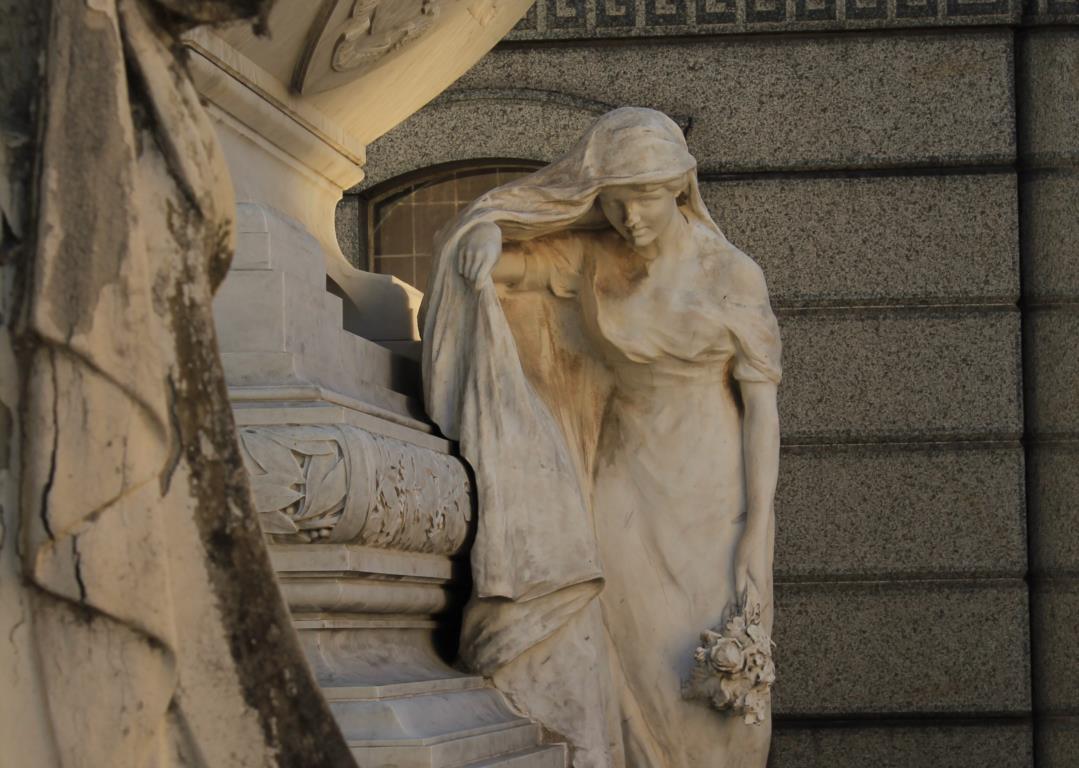
The best known is that of Rufina Cambaceres, a 19-year-old who died in 1902 and was buried after being diagnosed with cardiac syncope. Days later, her mother found the coffin lid had shifted, which gave rise to the belief that Rufina had been buried alive. Her vault is easy to recognize by the sculpture of the young woman with her hand resting on the door handle, as if trying to get out.
Another recurring story is that of Liliana Crociati, a young artist who died in an avalanche during her honeymoon in Austria in 1970. Her family built a neo-Gothic vault with a sculpture of Liliana in her wedding dress, accompanied by the figure of her dog Sabú, who had died that same day back in Buenos Aires.
The tour also includes the legend of the Lady in White, Luz María García Velloso, a young woman who died at 17, whose grave sits near the main entrance. And there's the story of David Alleno, a cemetery caretaker who worked there from childhood and saved his whole life so he could pay for his own grave, marked with a statue of him holding his work tools.
A lesser-known but equally striking story is that of businessman Alfredo Gath, a partner in the historic Gath y Cháves department store. Gripped by the fear of being buried alive — a fear that Rufina Cambaceres's own story had helped instill in society at the time — he had a coffin designed with a hydraulic mechanism that would let him escape if he turned out to still be alive after burial. He tested the system twelve times without any issues; according to legend, on the thirteenth time, no one activated the mechanism in time.
How to visit Recoleta Cemetery: tickets and tours
Planning your visit is simple, but it helps to know a few things beforehand: hours can vary, ticket pricing works differently depending on the visitor's country of origin, and there's more than one way to tour the cemetery with a guide.
The cemetery is located at Junín 1760, right in the Recoleta neighborhood, just a few blocks from the Basílica del Pilar and Plaza Francia. You can get there on foot from much of the neighborhood, by public transport, or by taxi. Here are the practical details for planning your visit.
Tickets to Recoleta Cemetery
General visiting hours run Monday through Sunday, from 9 am to 5 pm, though it's worth confirming before you go, since hours can vary by season. Tickets to Recoleta Cemetery are sold officially through the Buenos Aires City Government's ticket portal, and pricing differs depending on whether visitors are Argentine or foreign. The official system applies a different rate for each case, so it's best to check the current price before your visit rather than go by a fixed figure.
You can buy tickets in advance on the official site or directly at the cemetery entrance, where payment is accepted only by debit or credit card. If you're joining a guided tour with a fixed start time, it's a good idea to buy your ticket at least 15 minutes before meeting your guide, to avoid delays in the entry line — especially on weekends and holidays, when the cemetery gets more visitors.
Guided tours of Recoleta Cemetery
There are several ways to tour the cemetery with a guide, depending on your budget and the language you're after. The most affordable is the free tour of Recoleta Cemetery run by the City Government itself: free guided tours in Spanish that depart every hour from the main entrance, Monday to Friday from 10 am to 4 pm, and Saturdays, Sundays, and holidays from 9 am to 4 pm. This option doesn't require booking ahead, though group sizes are limited.
For those who prefer a more narrative-driven experience focused on specific stories and legends, there are private tours such as the Recoleta Cemetery walking tour, a two-hour guided visit that starts at the main entrance and moves through the cemetery's most sought-after stops: Eva Perón's grave, the Leloir family mausoleum, the story of Rufina Cambaceres, the tribute to Liliana Crociati and her dog, the mystery of the Lady in White, and Luis Ángel Firpo's vault, among other stops.
The tour is run in English, in small groups, and it's important to keep in mind that cemetery admission isn't included — you'll need to buy it separately before meeting your guide.
As for a "night tour" of Recoleta Cemetery, it's worth clarifying something before you go looking for one: the cemetery closes its gates at 5 pm, so it can't be toured at night. What does exist are nighttime walks through the Recoleta neighborhood that revisit the cemetery's same legends while strolling the surrounding streets after sunset.
Other attractions near Recoleta Cemetery
Just a few meters from the entrance stands the Basílica Nuestra Señora del Pilar, built on the same grounds once occupied by the Recoleto monks, and one of the best-preserved colonial churches in the city. Also nearby is Plaza Francia, which usually hosts a crafts fair on weekends, and the Museo Nacional de Bellas Artes, just a few blocks away, ideal for adding a cultural stop to the same day.
With the cemetery, the basilica, the plaza, and the neighborhood's cafés and bars, it's easy to put together a full afternoon in Recoleta without needing to head to another part of the city: the whole circuit can be done on foot, at an easy pace, within a radius of just a few blocks.
Recoleta Cemetery and its importance to the neighborhood
The cemetery gave the entire surrounding neighborhood its identity, and that relationship explains much of what you can see today, both inside and outside its gates. Understanding this history helps you appreciate the visit, since every mausoleum tells you something about the Buenos Aires that built it.
The neighborhood's name comes from the Recoleto monks, a religious order that had its convent on these grounds during colonial times. The convent's former orchard was chosen as the site for the city's first public cemetery, designed by French engineer Próspero Catelin. The neighboring Basílica Nuestra Señora del Pilar, which also belonged to that religious order, still stands next to the cemetery and is part of the same walk.
Toward the end of the 19th century, when Recoleta became the neighborhood of choice for Buenos Aires's wealthiest families, the cemetery became their go-to necropolis. That's when the competition began that shaped its current look: each family wanted a more impressive mausoleum than their neighbor's, and that quiet rivalry left behind one of the most important collections of funerary art in Latin America.
Why the Recoleta neighborhood has that name
The link between the cemetery and the neighborhood isn't just geographical. During colonial times, the Recoleto monks settled in this area and gave their name to both the convent and the neighborhood that grew up around it. When the convent lost its institutional standing, its grounds — including the orchard where the cemetery now stands — were put to other uses, and the burial ground ended up being the element that kept the area's original name alive.
That historical continuity is one of the reasons walking through Recoleta feels like moving through different layers of the same city: the Basílica del Pilar represents the colonial, religious era, while the cemetery and the mansions surrounding it reflect the Buenos Aires of the late 19th century, when the country was going through a period of strong economic expansion.
The cemetery's architecture and heritage
The cemetery's architectural richness is also a key chapter in its story. The mausoleums blend Neoclassical, Art Nouveau, and Art Deco styles, with marble and stained glass brought over from Europe, at a time when patrician families competed to leave behind an architectural testament to their status. That heritage didn't go unnoticed by the state: more than 90 vaults have been declared National Historic Monuments, and the cemetery as a whole has held that same recognition since 1946.
Walking its internal pathways feels different from visiting a conventional cemetery. There's no grass, and no distance between the graves: the mausoleums sit right up against each other, like buildings in a miniature city, and each one reflects the architectural taste of the family that built it. That combination of history, art, and architecture is the main reason the cemetery became one of Buenos Aires's most important tourist attractions.
A few examples help illustrate that variety of styles. The Dorrego-Ortiz Basualdo family pantheon is one of the largest in the cemetery, featuring a sculpture of a virgin lighting a seven-branched candelabra. The tomb of Admiral Guillermo Brown, founder of the Argentine Navy, is painted green in tribute to his Irish roots, and was built partly with bronze melted down from the cannons of the ships he commanded.