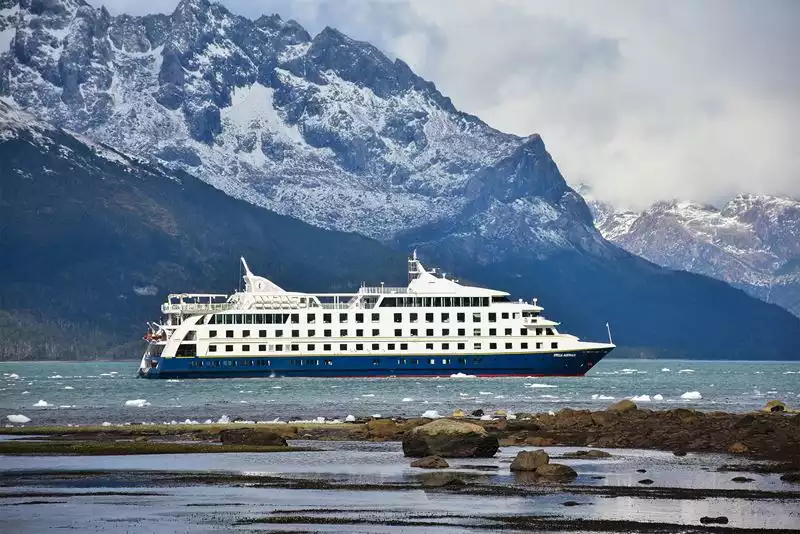
About this cruise
This Antarctic expedition is a complete immersion in the nature and history of the White Continent. Starting in Ushuaia, your journey will take you through the legendary Drake Passage, known for its turbulent waters and rich biodiversity. During this voyage, you will have the opportunity to observe a wide variety of seabirds, such as albatrosses, while the expedition team educates you about the ecology of the region. The onboard lecture program will prepare you for the adventure that awaits.
The heart of the expedition is the exploration of the Weddell Sea, a place of icy, tabular landscapes, evoking the sensation of a floating, undulating world. This area is home to one of the largest populations of Adélie penguins on the Antarctic Peninsula, offering heartwarming encounters. Cruising in this region will immerse you in the history of explorers like Otto Nordenskjöld, whose expedition left a legacy of survival and discovery in the area.
Continuing on your voyage, you`ll discover the beauty of the Antarctic Peninsula and the South Shetland Islands. You`ll sail through narrow channels like the Gerlache Strait and Lemaire Channel, surrounded by towering glaciers and rugged mountains. Landings allow you to explore iconic sites like Paradise Bay and Deception Island, where you can walk among colonies of penguins and fur seals. The expedition offers you an unparalleled opportunity to witness incredible Antarctic wildlife, including crabeater seals, Weddell seals, and whales, in a pristine environment of snow and ice.
Finally, the return to Ushuaia will give you time to reflect on this transformative experience. Throughout the trip, flexibility is key, as the expedition team will adjust the route to take full advantage of weather conditions and wildlife viewing opportunities, ensuring a unique and unforgettable adventure.
Itinerary
Day 1: Depart from Ushuaia
Embark in the afternoon and meet your expedition staff and speakers. After settling into your cabin, we`ll sail through the famous Beagle Channel, passing through the Mackinlay Passage.
Days 2 and 3: Crossing the Drake Passage
Named after famed explorer Sir Francis Drake sailed these waters in 1578, the Drake Passage marks the Antarctic Convergence, a natural biological barrier where frigid polar waters meet They dive beneath the warmer northern waters. This generates an abundance of nutrients, which support the biodiversity of this region. The Drake Passage also marks the northern limit for many Antarctic seabirds.
As we sail through the passage, our staff will be with you on deck to assist you in identifying the enormous variety of seabirds, including the albatrosses that shadow the USHUAIA. Our “open bridge” policy onboard will allow you to join our officers on the bridge and learn a few facts about navigation, go whale watching, or simply enjoy the view. A full program of lectures will be waiting for you.
The first icebergs and snow-capped mountains indicate that we have arrived in the South Shetland Islands, an archipelago of 20 islands and islets discovered in 1819 by Captain William Smith with his brig Williams. Should conditions in the Drake Passage be favorable, on the third day our expedition staff will accompany you on the first landing and experience the fascinating encounter with penguins and seals.
Days 4-6: Exploring the Weddell Sea
The immense tabular ice floes await us here. In certain years, the Erebus and Terror Gulfs and the Weddell Sea are completely ice-packed, making for exciting sailing. Get up early and go on deck! It may be 3:30 a.m., but you`ve probably never seen sunrises like this before. The enormous tabular icebergs from the Larsen, Ronne, and Filchner ice shelves, combined with year-old and multi-year sea ice, create a floating, undulating landscape of rugged ice. You may see snow petrels circling the ice floes, often accompanied by cape petrels.
The eastern part of the Antarctic Peninsula is usually reached by crossing the Antarctic Sound, which is 48 km (30 mi) long and 11–19 km (7–12 mi) wide and oriented northwest–southeast. Esperanza Bay and the Argentine base Esperanza are located on the western side of the Sound. Brown Bluff, a headland on the Tabarín Peninsula, is located south of Esperanza Bay. We plan to visit both sites if conditions permit. The Weddell Sea represents the center of the peninsular Adélie penguin population. Devil`s Island, Paulet Island, and the sites already mentioned will provide sufficient proof. The number of penguins is staggering. Sometimes juvenile emperor penguins have been seen on the ice floes, but this is by no means usual in the area. This region is also replete with vibrant tales of exploration history. The strangest of these stories involves the Swedish Antarctic Expedition of 1901–03 under the command of geologist Otto Nordenskjöld. Four sites commemorate this expedition: Esperanza Bay, Paulet Island, Snow Hill Island, and the Cape of Happy Encounter on Vega Island. Our expedition staff will be delighted to share this exciting story with you. Nordenskjöld`s expedition was the first to winter on the Peninsula. Their ship, the Antarctic, under the command of the famous Norwegian whaling captain Carl Anton Larsen, became trapped in the ice and sank, but the men survived in different locations and even managed to conduct significant scientific research in the area.
Days 7 and 8: Discovering the Antarctic Peninsula and the South Shetland Islands
At Learning about the remarkable history of the Antarctic Peninsula will thrill you in ways comparable to those of early explorers. You`ll have plenty of time to explore its incredible landscape—a pristine wilderness of snow, ice, mountains, and waterways—and its incredibly wide variety of wildlife. In addition to penguins and seabirds, you can also see crabeater, Weddell, and leopard seals up close, as well as humpback, minke, and orca whales.
We expect to sail some of the most beautiful channels, always depending on ice conditions: the Gerlache Strait, Neumayer Channel, and Lemaire Channel are narrow passages between imposing rocks and spectacular glaciers. Excursion sites may also include: Paradise Bay, literally the most well-named place in the world, with its majestic glaciers and mountains; Cuverville Island, home to the largest gentoo penguin colony on the Peninsula, surrounded by glaciers and towering crenellated icebergs; and a British Museum and post office at Port Lockroy.
We plan to explore the South Shetland Islands. This group of volcanic islands is teeming with wildlife. Vast penguin colonies, beaches ruled by Antarctic fur seals and southern elephant seals make every day here unforgettable. Sailing through the narrow passage into the flooded caldera of Deception Island is truly breathtaking, as is visiting Halfmoon Island, home to chinstrap penguins against a breathtaking backdrop.
Days 9 10: Crossing the Drake Passage
We`ll leave the Antarctic Peninsula and head north, crossing the Drake Passage. Join our lecturers and naturalists on deck as they search for seabirds and whales, and enjoy some of the final lectures. Take some time to relax and reflect on the fascinating adventures of the past few days on the way back to Ushuaia.
Day 11: Arrival at the port of Ushuaia
We arrive in Ushuaia early in the morning, where you will disembark after breakfast.
N.B. The itinerary described above is only a guide. Our exact route and program may vary in order to take best advantage of the local weather, ice conditions and wildlife viewing opportunities. Changes will be made by the Captain and Expedition Leader to facilitate the best results under the prevailing conditions, always with the objective of reaching the Weddell Sea. However, should ice conditions affect the transit, the route may be changed to a route around the western Antarctic Peninsula. A daily program will be published on board. Flexibility is the key to success.