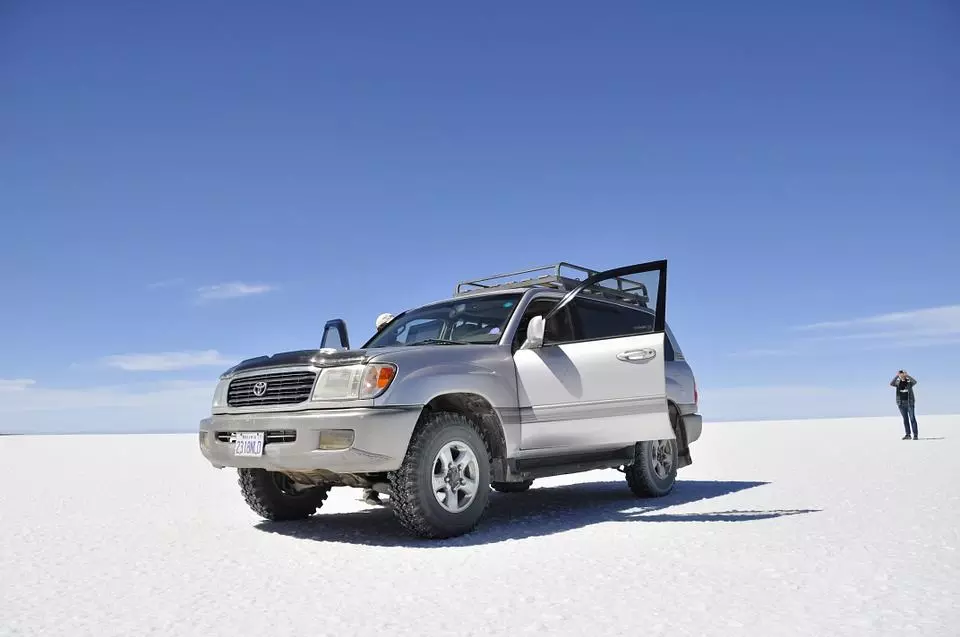
The Salar de Uyuni sits in southwestern Bolivia, in the Potosí department, and its vast expanse of salt and surreal landscapes draws visitors from all over the world every year. You don't need to book a tour to explore Bolivia's salt flats. If you're planning a trip like this, this guide can help you plan your visit.
First, here's what to know about the Salar de Uyuni before you travel:
- Altitude: approximately 3,650 meters above sea level
- Surface area: over 10,000 km², the largest salt flat in the world
- Starting point: the town of Uyuni, Potosí department
- Train Cemetery: 3 km from downtown Uyuni, free and open access, on foot (30 min) or by bike (15 min)
- Incahuasi Island: optional entry fee of 30 Bs; unavailable during the rainy season
- Mirror effect: from January to early March
Safety tip: if you're going without a guide, don't stray from the tour jeeps or venture too deep into the salt flat — GPS can fail out there and there are no visible landmarks
If you'd rather have everything arranged in advance once you land in Bolivia, you can go with our Salar de Uyuni travel package, which includes the Laguna Colorada and the Great Salt Flat over 3 days.
Either way, let's start with how to get to the nearest town, Uyuni, and what to do from there.
Where is the Salar de Uyuni and how do you get there?
The Salar de Uyuni is located in Bolivia's Altiplano region, near the town of Uyuni, which is the main starting point for visiting it. It's the largest salt flat in the world, covering more than 10,000 km², formed thousands of years ago after a prehistoric lake evaporated.
Both the town of Uyuni and the salt flat itself sit at around 3,650 meters above sea level, an altitude that can bring on mild symptoms like headaches or fatigue. If you're traveling without the backup of an agency, it's important to take it easy for the first few days, stay well hydrated, and avoid intense physical exertion until you've acclimatized.
Below is a guide to reaching Uyuni from nearby Bolivian cities and neighboring countries.

From Sucre
Daily buses run from Sucre to Uyuni, and the trip takes about 8 hours. Two companies operate this route, covering roughly 320 kilometers: Expreso 11 de Julio, which uses regular-seat buses, and 6 de Octubre, with semi-cama (semi-reclining) buses.
From La Paz
The distance from La Paz to the Salar de Uyuni is about 550 kilometers, and there are three ways to cover it.
By plane, it takes less than an hour, but as always, it's the priciest option. Flights are frequent, making this a good choice for shorter stays.
The bus is the second option, and a bit cheaper. The trip takes around 8 to 10 hours, with good frequency. Taking an overnight bus from La Paz to Uyuni also saves you a night's accommodation.
Finally, you can go by train. Service is less frequent and involves a bus from La Paz to the Oruro train station, 3 hours away; from there, the train reaches Uyuni in 7 hours. It's a scenic experience, though with limited schedules. Those who've done it often say they'd do it again, mainly for the views along the way.
From other Bolivian cities
Santa Cruz de la Sierra and Cochabamba are among the cities you can travel from to reach Uyuni. You can fly from Santa Cruz de la Sierra on Tuesdays, Thursdays, and Sundays, on flights of just over an hour. Buses, on the other hand, require a transfer in Sucre.
From Cochabamba, direct buses take 12 hours and leave at night.
From Calama, Chile
Many travelers in the region look to travel from northern Chile to Uyuni. San Pedro de Atacama and Antofagasta are two spots where you're likely to run into plenty of travelers, and Calama is the best city to depart from. The distance is about 350 kilometers.
Buses leave from Calama to Uyuni every day. Two companies, Cruz del Norte and Trans Salvador, offer semi-cama service, and the trip takes around 8 hours.
From Salta, Argentina
Northern Argentina borders Bolivia, so you can also travel from there. Salta is about 600 kilometers from Uyuni, and it's also a gateway for travelers looking to visit Purmamarca, the Salinas Grandes, and Humahuaca.
To reach Uyuni, you'll need to pass through the border town of La Quiaca, reachable by bus from Salta or towns like Tilcara and Purmamarca. From there, you cross the border into Villazón, Bolivia, to catch a bus or train. The bus takes 7 hours and departs in the morning and afternoon. The train from Villazón to Uyuni takes about 9 hours.
Once you arrive in Uyuni
Local buses from Uyuni run along the edge of the salt flat, stopping in nearby towns. One of these is Llica, which the bus reaches by crossing the salt flat itself. The buses pass by Incahuasi Island, where you can get off if you're interested. From there, a bus continues on to Llica, where there's lodging for the night.
Another town reachable by local bus is Colchani. You could also try hitchhiking here, since it sits on a main road. Once in town, there are a few hotels right on the edge of the salt flat, like the Palacio de Sal and the Hostal Dulce Salada.

How to get onto the Salar de Uyuni without a tour
Reaching the town of Uyuni is only half the journey — to actually set foot on the salt flat itself without booking an excursion, there are two options. The first is having your own or a rented 4x4 vehicle, which lets you drive onto the flat on your own and plan your own route. The second is taking one of the local buses that cross the flat toward Llica or Colchani, which make stops along the way and let you get off at points like Incahuasi Island.
Before settling on the self-drive option, keep in mind a warning repeated by those who've done it: venturing too far into the salt flat can be risky, since there are no signs or visible landmarks to navigate by, and GPS can fail in that area. If you're driving on your own, the most common advice is to keep one of the many tour jeeps that circulate around the flat within sight, and not to head toward the center if you don't have experience with this kind of terrain.
Train Cemetery: the free stop before the salt flat
Just 3 kilometers from downtown Uyuni is the Train Cemetery, one of the few attractions in the area you can visit without paying an entry fee or booking any service. You can walk there in about 30 minutes, bike it in 15, or take a taxi if you'd rather save time.
The site is home to rusted locomotives and train cars dating back to the late 19th century, when Uyuni was a key railway hub for transporting minerals to the port of Antofagasta, in Chile. After the mining industry collapsed in the 1940s, the trains were left abandoned in the middle of the desert, and today they're one of the most photographed spots before heading into the salt flat. Bring comfortable shoes, sunscreen, and water, since the site is fully exposed with practically no shade.
Sunset at the Salar de Uyuni
Sunset at the Salar de Uyuni is a magical experience. During the dry season, the sky turns shades of orange and pink, while during the rainy season, the sky's reflection on the water creates an infinite mirror effect. The best spots to enjoy the sunset are:
- Incahuasi Island: With its giant cacti and rock formations.
- Ojos de Sal (Salt Eyes): Small pools of water that bubble up on the surface of the salt flat.
- Playa Blanca (White Beach): A quiet, out-of-the-way spot, perfect for enjoying the silence.
If you're planning to visit Incahuasi Island before reaching the Salar de Uyuni, keep in mind that entry has an optional cost of 30 bolivianos, charged at a reception center run by the joint municipal authority of Llica and Tahua, which gives access to a well-marked trail among the giant cacti. The island isn't accessible during the rainy season, so if you're traveling between December and March, it's worth confirming it's open before adding it to your itinerary.
What's the best time to visit the Salar de Uyuni?
- Dry season (May to October): Ideal for exploring the salt flat by vehicle and enjoying its salt formations and desert landscapes. Temperatures are cold, especially at night.
- Rainy season (December to March): During this time, a mirror effect forms on the Salar de Uyuni, reflecting the sky and creating a stunning visual effect. It's the best time for unique photos, although access to some areas may be limited.
Is it safe to visit the Salar de Uyuni without a tour?
It's possible, but it requires caution. If you're driving your own vehicle, don't stray from the tour jeeps or venture into the salt flat without experience, since GPS can fail and there are no visible landmarks. The safest option for those without a vehicle is to take a local bus that crosses the salt flat toward Llica or Colchani.
Can you walk to the Train Cemetery?
Yes. It's about 3 kilometers from downtown Uyuni, roughly a 30-minute walk or a 15-minute bike ride, and entry is free and open to everyone.
When can you see the mirror effect at the Salar de Uyuni?
Generally between January and early March, during the rainy season, when a thin layer of water covers the salt flat and reflects the sky.